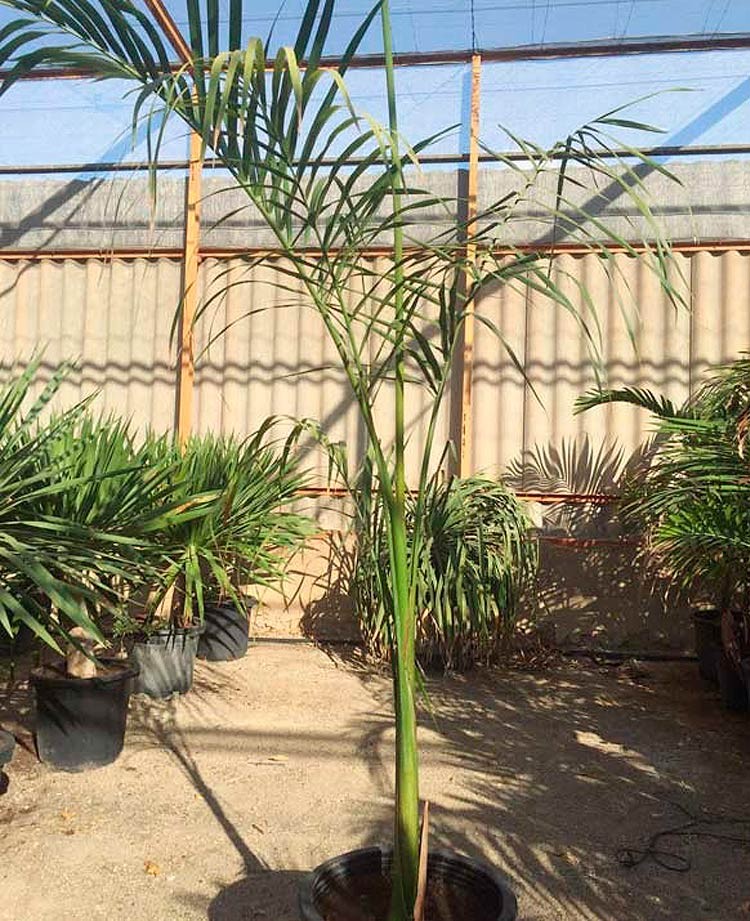

The Roystonea Regia is a very aesthetic palm tree that is highly valued for use as decoration for gardens or interiors. It is endemic to certain regions of South America and Florida. Its large wingspan, its characteristic trunk and its large leaves make it a striking palm tree that is very easy to care for, making it a highly valued palm tree.
 Shipments to Spain and Portugal ...
The cost of transportation depends on the province or country.
REAL CUBAN PALM TREE
This palm tree is commonly known as "Royal Cuban Palm" but its scientific name is "Roystonea Regia", being one of the most common palms that are incorporated into our garden, due to its rapid growth, easy cultivation and beauty of palm trees. yours. The common name itself says it, it is endemic to Cuba, although it is also native to Florida, Puerto Rico, Honduras, among others. It is a very thin palm that reaches up to 25 meters in height, just from the stipulation (trunk). In very exceptional cases and in its natural habitat, it can reach 40 meters in height. Its trunk is characterized by being stipulated, smooth, grayish in color, wider at the bottom and increasingly more stylized as it approaches the glass. Its leaves are distinguished by their enormous size, the latter being pinnate. Its inflorescence is born between the palms of the leaves, which branch to give flowers and fruits (berries). It is perfect for planting outdoors, especially in damp soil. It resists cold climates, holding up to 2 degrees below zero.
An interesting fact about this palm tree is that in Cuba it is considered a sacred tree in a religion that can be found in this territory. This religion is known as the Regla de Ochoa (government of the gods). They call it the palm of Alabbi, placing the various offerings that they leave to the gods at their feet.
CARE FOR YOUR PALM TREES
Las Palmeras can be had both indoors and outdoors. There are varieties that are better adapted to the outdoors or garden, and there are others better adapted to live indoors and in pots.
Indoors
- Plants in general prefer places with direct light or that have good lighting, it will always be preferable next to a window, on a balcony or on a terrace.
- It is essential that they have good drainage, both in soil and in pot. It is advisable to put a layer of engraving on the bottom of the pot.
- The ideal substrate for palm trees has to be rich in organic matter, a good worm humus.
- Irrigation has to be every 3 or 4 days, before making sure that the substrate is dry, excess water is not good.
Outside
- There are palm trees that prefer direct sun and others prefer more shady areas, it is also very important to take into account the climate of the place where you live, there are palm trees well adapted to low temperatures and other palm trees that prefer warmer climates.
- It is essential that they have good drainage, both in soil and in pot. Water puddles are not good for plants in general.
- The ideal substrate for palm trees has to be rich in organic matter, a good worm humus, Compost or Manure would be enough.
- Irrigation, as the palm tree is on the ground and being more intense than in a pot, it can be one watering a week.
- A preventive treatment against diseases with repeated spraying 3 or 4 times a year allows to keep some species of palm trees safe from possible pests.
Specific References
You might also like


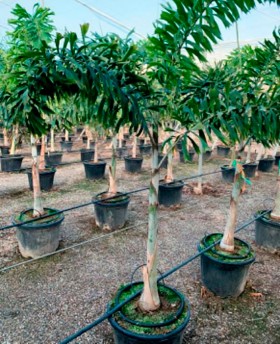
The Roystonea Regia is a very aesthetic palm tree that is highly valued for use as decoration for gardens or interiors. It is endemic to certain regions of South America and Florida. Its large wingspan, its characteristic trunk and its large leaves make it a striking palm tree that is very easy to care for, making it a highly valued palm tree.